



August 11, 2026, 15:00
Discover the difference between American and European blackjack and win more
Both variants share the same goal: beat the dealer with a hand as close to 21 as possible without going over. On the surface, the rules look almost identical. But one single difference changes everything: the hole card.
In American blackjack, the dealer receives a face-down card and checks early whether he has blackjack. In European blackjack, the dealer only gets his second card after every player has finished their hand. Sounds like a minor detail. It is not. That one rule affects every strategic decision you make at the table.
In this article we break down all the differences between American and European blackjack, from hole card and deck count to double rules, house edge and strategy. By the end, you will know exactly which variant suits you.
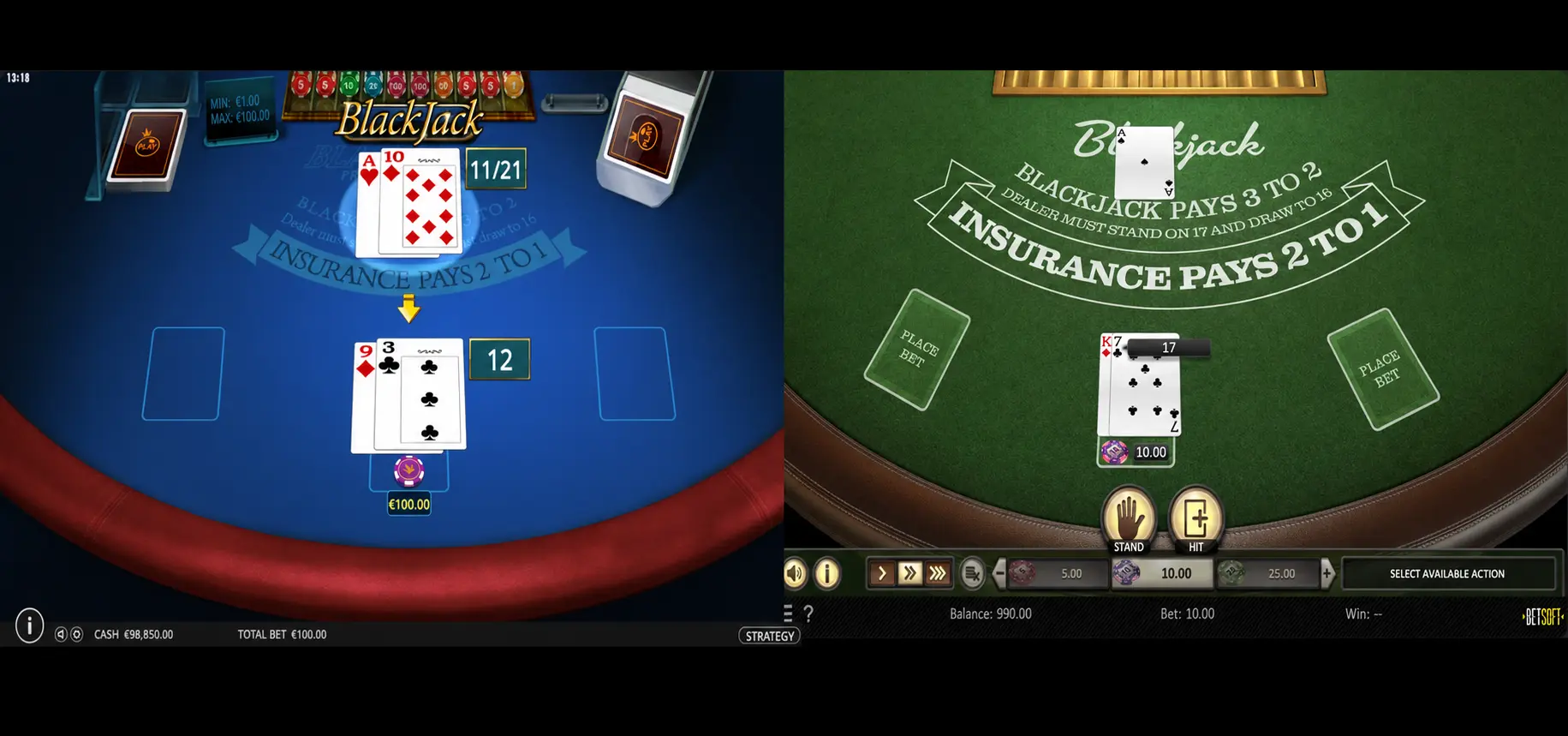
Want to try both? Play American and European blackjack for free in demo mode at PepperMill Casino.
The biggest difference: the hole card
The hole card is the face-down card the dealer receives at the start of a round. The core difference between the two variants is whether the card is dealt upfrona and if he immediately checks if it’s a blackjack.
American blackjack: peek
The dealer deals himself two cards: one face up, one face down. If the upcard is an ace or a ten-value card, he immediately checks whether he has blackjack. That is called peeking. If he does have blackjack, the hand ends right there. You only lose your original bet, not any extra money placed through a double or split. That protection is a real, concrete advantage for the player.
European blackjack: no peek
The dealer does not receive his second card until all players have completed their hands. There is no hole card while you are playing. That means you can double or split against a dealer who turns out to have blackjack. And yes, you lose those extra bets too. The no-peek rule offers no safety net.
That single distinction, peek versus no peek, makes American blackjack slightly more favourable for the player. Every other rule difference builds on this one.
The differences at a glance
| Rule | American Blackjack | European Blackjack |
| Hole card | Yes, dealer peeks | No, dealer does not peek |
| Number of decks | 6 to 8 | 1 to 2 |
| Double down | On any hand | On 9, 10 or 11 only |
| Double after split | Usually allowed | Usually not allowed |
| Re-split | Allowed (often up to 3x) | Limited, usually once |
| Surrender | Often available | Not available |
| Blackjack payout | 3:2 or 6:5 | Usually 3:2 |
| House edge | Slightly lower | Slightly higher |
American blackjack is more flexible on almost every front. More doubling options, re-splits, surrender and peek protection give you more tools to play with. European blackjack partly makes up for that with fewer decks, but overall American remains the slightly better deal for the player.
Which variant has the lower house edge?
With perfect basic strategy, both variants sit close to a house edge of around 0.5%. That said, a few structural factors tip the balance in favour of American blackjack.
Why American blackjack edges ahead
The peek rule limits your losses when the dealer has blackjack. Extra bets placed through doubles or splits stay protected. Wider doubling and splitting options let you capitalise more often when the situation calls for it. And surrender gives you a way out when your hand is weak, saving half your bet instead of losing it all.
Where European blackjack has the edge
Fewer decks. Playing with 1 to 2 decks rather than 6 to 8 does lower the house edge slightly. But that advantage does not outweigh the no-peek rule and the restricted playing options.
Net result: American blackjack is usually the better deal, though the difference is small. What makes a much bigger difference is the payout. Always avoid tables that pay 6:5 instead of 3:2, regardless of the variant. A 6:5 payout adds more than 1.3% to the house edge, wiping out any gains from good strategy in an instant.
Strategy differences between the two variants
The basic strategy is largely the same in both games. But the no-peek rule in European blackjack calls for a more cautious approach in specific situations.
Adjustments for European blackjack
Because the dealer only takes his second card after your decisions are made, doubling or splitting against a strong dealer upcard carries more risk. A few practical adjustments:
· Be more conservative about doubling and splitting when the dealer shows an ace or ten-value card. He could still have blackjack, and you would lose all your extra bets.
· Never split tens, especially against a strong dealer upcard.
· Only double on 9, 10 or 11, in line with the stricter double rules of European blackjack.
Adjustments for American blackjack
Here you can afford to play more aggressively. The peek protection absorbs the risk of a dealer blackjack, so you can confidently double and split in the situations where strategy calls for it. Make use of the wider options and use surrender when your hand looks weak against a strong dealer.
American or European blackjack: which do you choose?
Both are great games. The right choice comes down to your playing style and what you want from your time at the table.
Choose American blackjack if you...
✓ want the slightly lower house edge that comes with the peek rule
✓ prefer to double and split more freely
✓ want the option to surrender when your hand looks shaky
✓ enjoy variety through sub-variants like Atlantic City, Vegas Strip or Spanish 21
Choose European blackjack if you...
✓ prefer a straightforward game with fewer rule variations
✓ like playing with fewer decks
✓ want a fixed 3:2 payout without surprises
✓ favour a more careful, defensive playing style
Play both American and European blackjack at PepperMill Casino and find out which one feels right for you.
What’s the difference between American and European blackjack?
The main difference is the hole card. American blackjack dealers get a face-down card and peeks for blackjack when showing an ace or ten-value card. European blackjack dealers only receive their second card after all players have finished. The two variants also differ in deck count, doubling and splitting options, and the availability of surrender.
Which variant is better for the player?
American blackjack is generally slightly more favourable, thanks to the peek rule, broader double and split options, and the surrender option. The house edge difference is small but real, and it grows the more you can make use of the flexible rules.
How many decks are used?
American blackjack uses 6 to 8 decks. European blackjack mostly uses 1 to 2. Fewer decks do lower the house edge slightly, but not enough to offset the more restrictive rules and the lack of peek protection in the European variant.
Can I surrender in European blackjack?
No. Surrender, where you take back half your bet on a weak hand, is only available in American blackjack and some sub-variants. In European blackjack, you always play your hand out to the end.
Is the strategy different between the two?
Mostly the same, with one key adjustment. European blackjack calls for more caution. Hold back on doubling and splitting when the dealer shows a strong upcard, since he could still have blackjack and you would not know until it is too late. In American blackjack, the peek rule protects your extra bets, making a more aggressive approach perfectly reasonable.
 Blog
Blog